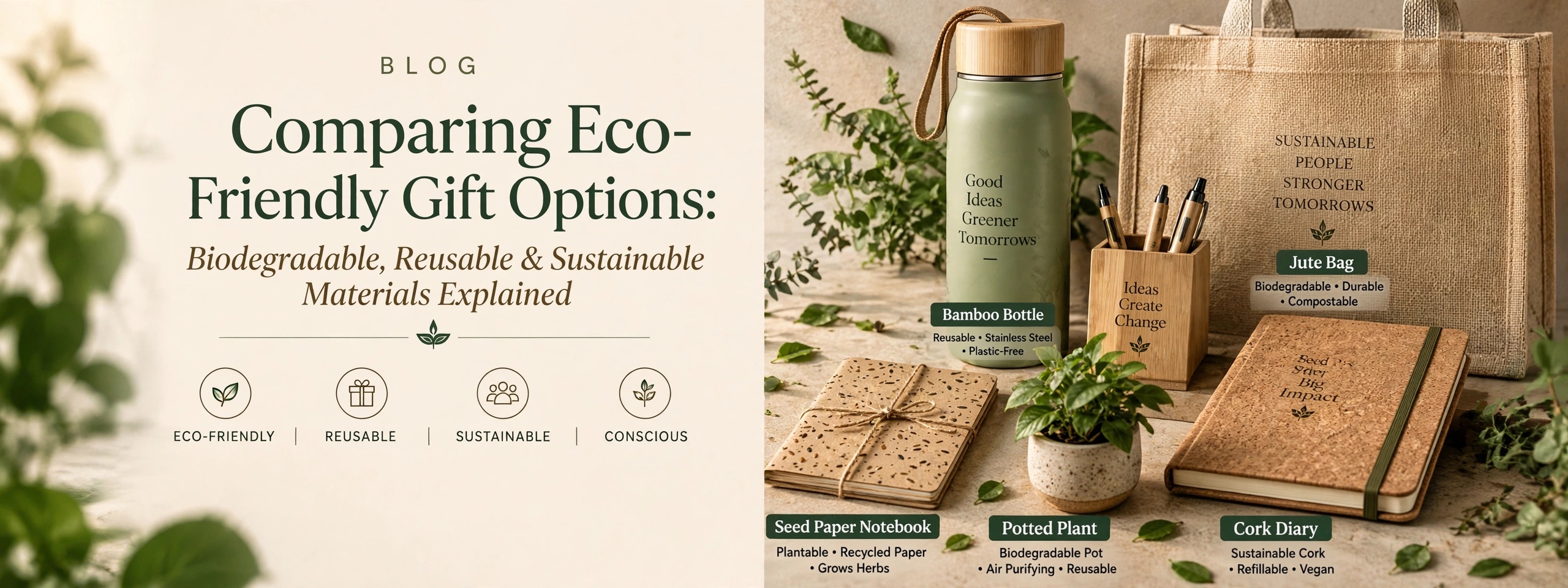
Eco-friendly gifting has moved beyond a simple preference for
"natural-looking" products. Today, more people are asking a better
question: what actually makes a gift sustainable?
A product may be made from a natural material and still have
environmental impacts from manufacturing, transportation, packaging
or disposal. Likewise, a reusable product may have a larger initial
material footprint but become a better choice when it is used many
times.
This is why choosing sustainable return gifts requires more than
looking for labels such as biodegradable, reusable or eco-friendly.
It helps to consider the entire life cycle of the product — from the
material used to make it, through production and use, to what happens
when the product is no longer needed.
In this guide, we compare biodegradable, reusable and other
sustainable material options commonly considered for wedding return
gifts, festive gifting, corporate gifting and Indian celebrations.
What Does Eco-Friendly Really Mean?
The term "eco-friendly" is often used broadly, but sustainability is
better understood as a life-cycle question. A material has an
environmental footprint at different stages: raw-material extraction,
processing, manufacturing, transportation, use and end-of-life
management.
The U.S. Environmental Protection Agency's sustainable materials
management approach specifically recommends looking at materials
across their entire life cycle rather than focusing only on what
happens after a product becomes waste.
The important takeaway:
A biodegradable product is not automatically the most sustainable
option, and a reusable product is not automatically better in every
situation. The right choice depends on material use, durability,
frequency of reuse, manufacturing, transportation and what happens
at the end of its useful life.
For wedding and event gifting, this means looking beyond the appearance
of the gift. A useful gift that guests continue using can potentially
avoid becoming immediate waste. A biodegradable gift can also be a
strong choice when it is made from appropriate materials and can
return to natural systems through suitable end-of-life management.
Reduce, Reuse, Recycle: What Does the Research Say?
One of the most useful ways to understand sustainable gifting is to
look at the waste-management hierarchy. The EPA places source
reduction and reuse above recycling and composting because preventing
waste in the first place can avoid the environmental impacts associated
with producing and managing additional material.
That does not mean recycling or composting are unimportant. They remain
valuable options when reduction and reuse are not practical. The key
idea is to think about the material before it becomes waste.
Research-Based Materials Management Priority
Higher position indicates a more preferred strategy in the
EPA waste-management hierarchy. This is a priority ranking,
not a numerical environmental-impact score.
Source Reduction
Highest Priority
Recycling / Composting
Next Preference
Energy Recovery
Lower Preference
Landfill / Disposal
Lowest Preference
For gifting, this gives us an important principle: if a product is
designed to be useful and reused, it can potentially keep its material
value in circulation for longer. If reuse is not realistic, selecting
materials that can be appropriately recycled or composted may provide
a better end-of-life pathway than a product designed only for disposal.
Comparing Eco-Friendly Materials for Gifts
There is no single material that is perfect for every occasion.
Different materials offer different combinations of durability,
reusability, biodegradability, appearance and practical usefulness.
01
Natural Material
Palm Leaf
Palm-leaf products are popular for traditional and
eco-conscious gifting because they use plant-based material
and can bring a distinctly handmade character to a gift.
They are especially suitable when the goal is a rustic,
traditional or natural aesthetic rather than a highly
polished modern finish.
Good for:
Wedding return gifts, festive gifting, thamboolam-style
presentation and traditional celebrations.
02
Plant-Based Fibre
Jute
Jute is a natural plant fibre widely used for bags, pouches,
packaging and gifting products. Its strength makes it useful
for products that are intended to be used beyond the event.
A jute bag can become part of the guest's everyday life,
making its usefulness an important part of its sustainability
story.
Good for:
Return gift bags, wedding hampers, corporate gifting and
reusable shopping or storage bags.
03
Reusable Textile
Cotton & Fabric
Fabric-based gifts can offer a reusable alternative to
disposable packaging. Pouches, potli bags, cloth bags and
textile organisers can continue to serve a purpose after
the celebration.
The sustainability advantage comes largely from continued
use, so choosing a practical design can be more meaningful
than choosing fabric simply because it looks natural.
Good for:
Potli bags, pouches, textile gifting, festive hampers and
reusable packaging.
04
Recyclable Option
Paper & Cardboard
Paper and cardboard can be useful for tags, boxes, packaging
and presentation. Their sustainability depends on factors
including material sourcing, coatings, inks, durability and
whether appropriate recycling infrastructure exists.
Paper packaging can be a practical choice when the amount of
material is kept low and the packaging has a clear recovery
pathway.
Good for:
Gift boxes, tags, inserts, lightweight packaging and
presentation.
05
Durable Material
Bamboo & Wood
Durable natural materials such as bamboo and wood can work
well for gifts intended to have a long useful life. Their
environmental profile depends on sourcing, processing,
finishes and how long the product remains in use.
A durable wooden gift that becomes part of a home can have
a very different life cycle from a disposable decorative
item.
Good for:
Home décor, utility gifts, organisers, trays and keepsakes.
06
Long-Use Option
Metal
Metal is not biodegradable, but that does not automatically
make it an unsustainable gift. Durable metal products can
remain useful for many years, and metals can also have
established recycling pathways.
This is an important reminder that biodegradability is only
one part of the sustainability conversation.
Good for:
Brass gifts, utility products, décor, keepsakes and
long-lasting wedding gifts.
Biodegradable vs Reusable vs Recyclable
These three terms describe different sustainability characteristics.
They should not be treated as interchangeable.
|
Type |
Main Advantage |
What to Consider |
Best Use |
|---|
|
Biodegradable |
Can break down through biological processes under
suitable conditions. |
End-of-life conditions matter. "Biodegradable"
does not mean immediate or universal decomposition. |
Natural-material gifts and products where suitable
end-of-life management is available. |
|
Reusable |
Keeps the product in use for longer and can reduce
demand for replacements. |
The product needs to be genuinely useful and reused
enough to justify its material footprint. |
Bags, pouches, organisers, containers and household
utility gifts. |
|
Recyclable |
Material can potentially be recovered and made into
new products. |
Actual recycling depends on collection, sorting,
processing and local infrastructure. |
Paper, cardboard, metals and other materials with
established recovery systems. |
Why this distinction matters:
A reusable product can sometimes be preferable because it remains
useful instead of becoming waste immediately. A biodegradable product
can be valuable when appropriate end-of-life conditions exist.
A recyclable material is useful when it can actually enter a recovery
system. The best option depends on the product's complete life cycle.
How to Choose the Right Sustainable Gift
For weddings and celebrations, the most sustainable gift is often
one that combines responsible material choices with genuine usefulness.
Before choosing a return gift, ask a few simple questions.
Will Guests Use It?
A practical gift has a better chance of staying in use rather
than becoming immediate waste.
Is It Durable?
Durability can matter as much as the material itself when
considering the useful life of a product.
Is Packaging Necessary?
Avoiding unnecessary layers of packaging can reduce material
use before the gift even reaches the guest.
Can It Be Reused?
Think about whether the recipient can use the item at home,
while travelling, for storage or in everyday life.
What Happens After Use?
Consider whether the material can be reused, recycled,
composted or otherwise responsibly managed.
Is It Locally Relevant?
A gift that suits the recipient's culture, lifestyle and
home is more likely to remain useful.
For Indian Wedding Return Gifts
Indian weddings offer many opportunities for sustainable gifting.
Jute bags, palm-leaf products, fabric pouches, reusable potli bags,
wooden utility items, brass products and thoughtfully designed
hampers can all work in different ways.
Instead of selecting a gift only because it is described as
"eco-friendly", consider whether it fits the guest, the occasion and
the product's intended life. A simple reusable bag that is used for
months can be more meaningful than a decorative item that is quickly
discarded.
Sustainable Gifting Is About More Than Materials
Sustainability begins before the product is manufactured. Choosing
an appropriate quantity, avoiding unnecessary packaging, selecting
useful designs and reducing excess material can all contribute to a
more thoughtful gifting strategy.
-
Choose useful gifts rather than purely disposable novelty items.
-
Prefer products designed for repeated use when practical.
-
Avoid unnecessary layers of plastic packaging.
-
Consider the durability and useful life of the product.
-
Look at the complete material life cycle rather than only the
word "biodegradable".
-
Consider whether the material has a realistic recycling,
composting or reuse pathway after the event.
-
Choose a design that guests can realistically use after the
celebration.
Frequently Asked Questions About Eco-Friendly Gifts
The Better Eco-Friendly Gift Is the One With a Longer Purpose
There is no single material that wins every sustainability comparison.
Palm leaf, jute, fabric, paper, wood, bamboo and metal all have
different characteristics and different roles in a responsible
gifting strategy.
The better question is not simply, "Is this biodegradable?" Instead,
ask: How much material is being used? How long will the product last?
Will the recipient actually use it? Can it be reused? And what happens
when its useful life ends?
For wedding return gifts and festive celebrations, thoughtful
sustainable gifting means balancing tradition, usefulness,
craftsmanship and responsible material choices. A beautiful gift
becomes even more meaningful when it continues to have a purpose
after the celebration is over.
Related Eco-Friendly Gifting Searches
eco friendly return gifts, eco friendly wedding return gifts,
sustainable return gifts, biodegradable return gifts, reusable
return gifts, sustainable wedding gifts, eco friendly wedding gifts,
eco friendly gifts India, sustainable gifting ideas, eco friendly
gifting ideas, biodegradable gifts, reusable gifts, natural material
gifts, jute return gifts, palm leaf return gifts, handmade eco
friendly gifts, sustainable wedding favors, eco friendly wedding
favors, eco friendly corporate gifts, sustainable corporate gifting,
eco friendly Indian wedding gifts, handmade return gifts,
traditional eco friendly gifts, sustainable Indian gifting,
environmentally friendly return gifts, eco conscious wedding gifts,
bulk eco friendly return gifts, sustainable return gifts India.
Looking for Sustainable Return Gifts?
Explore handcrafted gifting options made for Indian weddings,
celebrations and thoughtful occasions, with materials and designs
selected to balance beauty, usefulness and tradition.
Explore Kavyatva Gifts