

Every Material Has a Story
When we talk about Indian handicrafts, it is easy to begin with the finished object: a basket, a brass diya, a painted tray or a Potli bag. But the more interesting story begins earlier, with the material itself.
Palm leaf, natural fibre, jute, metal, cotton and painted textiles have all found their own place in Indian craft traditions. They are shaped by local resources, regional skills and generations of making. That is why two gifts that look completely different can still share the same quality: they carry a sense of place.
For gifting, this matters. A handcrafted return gift is not only something beautiful to give a guest. It can also introduce them to a material, craft tradition or making style they may not have encountered before.
Palm Leaf: A Material Rooted in South Indian Craft
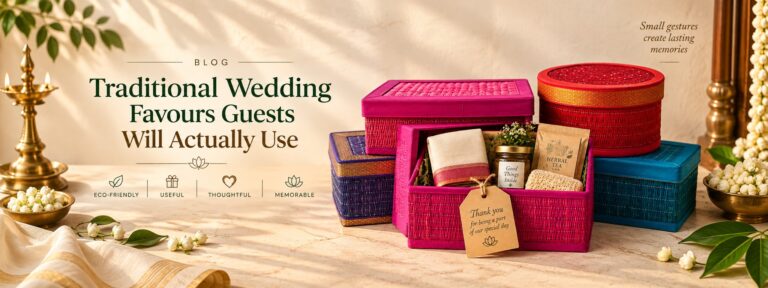
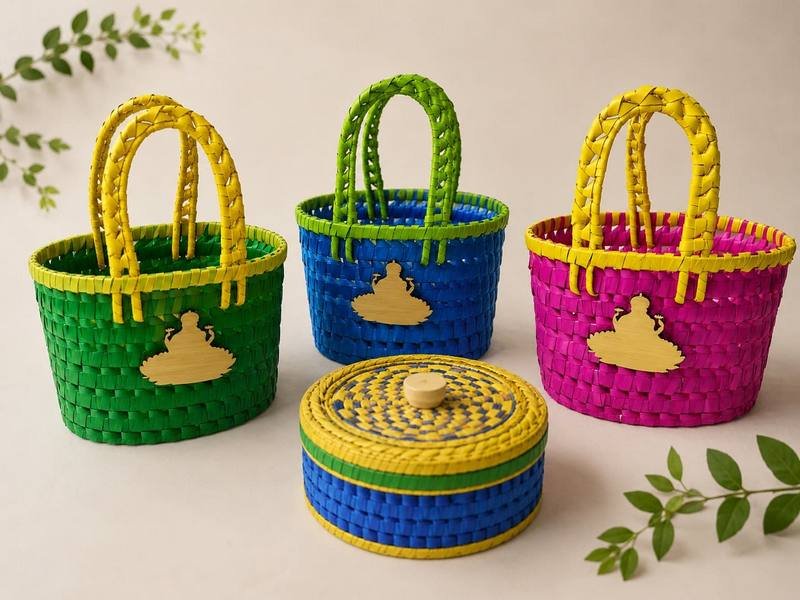
Palm-leaf craft is one of the most recognisable examples of natural-fibre craftsmanship in South India. One particularly distinctive tradition is the Chettinad Kottan, a hand-woven palm-leaf basket associated with the Chettinad region of Tamil Nadu.
The Office of the Development Commissioner (Handicrafts), Government of India, records Chettinad Kottan as a GI-registered craft. The traditional baskets are made from strips of locally available palm leaf and are known for their distinctive weaving style and colours. They were also traditionally used as containers and for presenting gifts and other articles. citeturn657395search12
That history makes palm-leaf baskets especially interesting for wedding gifting. The container itself becomes part of the gesture, whether it is used for sweets, small keepsakes, bangles or a curated Thamboolam arrangement.
River Grass and Natural Fibre Crafts
Natural-fibre crafts have a very different visual language from polished metal or embellished textiles. Their appeal comes from texture, weaving and the natural character of the material. They work particularly well when the goal is to create a gift that feels warm, grounded and less formal.
Natural-fibre craft is also a broad field rather than a single technique. Government handicraft resources list palm leaf, banana fibre, jute, cane, bamboo and other natural-fibre crafts across different Indian regions.
River Grass Weaves
Soft woven textures suit baskets, organisers and gift containers where the material itself is meant to remain visible.
Jute
Jute works naturally for pouches, bags and hamper packaging, particularly when the gift needs a practical second life.
Palm Leaf
Palm-leaf products bring a distinctly Indian handmade character to return gifts, festive packaging and home accessories.
Grass & Fibre Crafts
Across India, natural fibres are turned into baskets, mats, containers and decorative objects through regional craft traditions.
Metal Crafts: When a Gift Is Meant to Last
Metal changes the language of a gift completely. Brass, bronze and other metal crafts can feel more ceremonial because the object is designed to remain in the home rather than disappear after the occasion.
India's decorative arts traditions include manually made metal utensils and objects alongside textiles, ceramics, woodwork and jewellery. The National Museum describes decorative arts as a way of understanding the social, religious, commercial and technological history of a culture.
For wedding gifting
Brass diyas, small vessels, traditional trays and other compact metal objects can make the gift feel ceremonial without becoming difficult to carry.
For premium gifting
Larger or more detailed metal pieces can work well when the intention is to give something that becomes part of the recipient's home or festive traditions.
Pichwai: When the Surface Becomes the Story
Some crafts are defined less by the raw material and more by the artwork applied to it. Pichwai is a good example. The tradition is closely associated with Nathdwara and devotional imagery, and its visual vocabulary is often seen in contemporary home décor, textiles and gifting products.
For Kavyatva, Pichwai works particularly well where the gift needs a stronger visual identity: a tray, box, wall piece or decorative surface can carry the character of the artwork without requiring the object itself to be elaborate.
Kalamkari and the Character of Indian Textiles
Indian textile crafts bring a different kind of richness to gifting because the surface can carry pattern, colour, storytelling and regional identity. Kalamkari, for example, is represented among India's recognised GI handicraft traditions, including Srikalahasthi Kalamkari and Machilipatnam Kalamkari. citeturn657395search16
That makes Kalamkari-inspired textiles a natural choice for Potlis, bags, runners, pouches and soft gift packaging. Unlike a disposable wrapper, a textile layer can continue to be useful after the wedding or festival.
Kalamkari
Detailed painted or printed textile traditions that bring pattern and narrative into gifting.
Embroidered Fabrics
Useful where a richer, more decorative Potli or pouch is part of the gift presentation.
How to Choose the Right Indian Craft Material for Gifting
The right material depends on what you want the gift to say. There is no single “best” Indian craft material for every occasion.
- For traditional wedding gifting: choose materials and forms that connect naturally with the ceremony, such as palm leaf, Potli textiles or brass.
- For eco-conscious gifting: look at natural fibres, reusable containers and packaging that can serve another purpose.
- For premium gifting: consider lasting materials such as brass or a carefully finished handcrafted object.
- For regional storytelling: choose a craft whose place of origin and technique can become part of the gift story.
- For bulk gifting: consider weight, consistency, production capacity, packing and transport before choosing the final material.
Why Material Matters in Modern Indian Gifting
The growing interest in handcrafted and conscious gifting is not simply about replacing one product with another. It is about making the object itself more meaningful. A palm-leaf basket can carry a regional craft tradition. A brass diya can become part of a family's festive routine. A textile Potli can be reused long after the wedding.
That is where thoughtful gifting becomes different from ordinary packaging. The material is no longer something hidden underneath the presentation. It becomes part of the reason the gift deserves to be kept.
Frequently Asked Questions
What are some traditional Indian materials used for handcrafted gifts?
What is a Chettinad Kottan?
Are natural-fibre gifts suitable for wedding return gifts?
What is the difference between a material and a craft?
Explore handcrafted materials and Indian-inspired gifting made for meaningful occasions.